> The Things You Can Read: Teaching Plot

The Things You Can Read welcomes you and thanks you for your readership. We, here at The Things You Can Read, ask your help, if you visit our site regularly, please follow us either via email or Google Friend Connect.  Launched on June 7, 2012, our site has already attracted a great deal of attention.  One of the goals of the site is to feature reviews of Children's Picture Books, Young Adult novels and Adult Literary Fiction/Nonfiction.  A second goal for the blog is to be a resource for teachers of English and writing--with examples of student created writing, writing tips, resource links, and the opportunity to pick the brain of a seasoned English teacher.  To spice things up...every now and then, we'll also include random quotes and thoughts on education and life in general, but our ultimate goal is to reach out into the blogosphere and be a "Book Whisperer" and "Writing Whisperer" to children and adults of all ages.   Thank you for your readership.  Here is to a lifetime filled with reading and writing.
Showing posts with label Teaching Plot. Show all posts

Tuesday, October 11, 2016

DO NOW: October 11 & 12, 2016


DO NOW:  October 11 & 12, 2016


A series of events that includes the conflict and complications of the story.
   
A.Exposition
B.Rising Action
C.Falling Action
D.Resolution
E.Initiating Event


Start Scribbling!
Believe In Truth, Beauty, Freedom, Love, and the Power of the Written Word

Don't Forget To Be Awesome!

ABOUT THE AUTHOR:

I am an educator with over 25 years of teaching experience; I currently teach English in the public school system of Virginia. In my spare time, I am an avid reader. writer, reviewer, blogger, writing/art journaler, beekeeper, grad student, and MOTHER. - See more: Here

Monday, October 10, 2016

Stroy Development: Things To Consider


  • How would you feel in Penelope’s situation?
  • What would you do if you were Penelope?
  • How do you think Penelope will try to get down from the treehouse?
  • What do you think will happen in the rest of the story?

Start Scribbling!
Believe In Truth, Beauty, Freedom, Love, and the Power of the Written Word


Don't Forget To Be Awesome!

ABOUT THE AUTHOR:

I am an educator with over 25 years of teaching experience; I currently teach English in the public school system of Virginia. In my spare time, I am an avid reader. writer, reviewer, blogger, writing/art journaler, beekeeper, grad student, and MOTHER. - See more: Here


Thursday, October 6, 2016

Do Now: PLOT October 7 & 10


Do Now PLOT October 7 & 10
The introductory material which gives the setting, creates the tone, presents the characters,
and presents other facts necessary to understanding the story.   
A.Plot
B.Resolution
C.Conclusion
D.Rising Action
EExposition


Don't Forget To Be Awesome!

ABOUT THE AUTHOR:

I am an educator with over 25 years of teaching experience; I currently teach
 English in the public school system of Virginia. In my spare time, I am an 
avid reader. writer, reviewer, blogger, writing/art journaler, beekeeper, 
grad student, and MOTHER. - See more: Here


Wednesday, October 5, 2016

INTERACTIVE NOTEBOOK PAGE 3


Objective:  To identify elements of the plot when reading         fiction.


PAGE 3

 Notes for Writing Under Tabs:

flashback – the plot is interrupted to recreate an event of earlier time (BEFORE THE STORY STARTED); often used to provide background information

flash forward – a story begins with a brief look at the future, and then the reader gets to go back and find out how the characters got to that point

dream sequence – the author breaks the narrative to show what a character is dreaming; used to reveal more about a character

plot twist – an unexpected development in a story; a
surprise!

foreshadowing – hints or clues suggesting what may happen later in a story

parallel episodes – certain plot elements or events that repeat themselves throughout a story


Review of PLOT

Story Pyramid: Analyzing Stories

Words You Need to Know

Conflict: a problem that occurs in the story
Setting: time and place where the story occurs
Tragedy: a story ending in death and sadness

Analyze: to look at something very closely.
Most stories have the following parts: exposition (inciting incident), rising action, climax (turning point), falling action, and denouement (resolution).  This pyramid is used to show how stories move; it is a graphic plot chart. Sometimes a story can be more complicated than this pyramid, but most stories fit perfectly into the pyramid.

Let’s look at each part of the pyramid…

Exposition (inciting incident): The exposition is like the set-up of the story.  The background information that is needed to understand the story is provided, such as the main character, the setting, the basic conflict, and so forth.

The exposition ends with the inciting moment, which is the one incident in the story without which there would be no story. The inciting moment sets the rest of the story in motion.
Rising Action: Rising action is a series of events and actions that move the story to a climax.  During rising action, the basic conflict is complicated by secondary conflicts (obstacles and challenges that frustrate the main character’s attempt to reach their goal).
Climax (turning point): The climax is the turning point in the story.  After the climax everything changes.  In most stories, things will have gone badly for the main character up to this point; after the climax, things will begin to go well for him or her.  However, if the story is a tragedy, the opposite will happen after the climax: things that have been going good for the main character begin to go bad.
Falling Action:  During the falling action, the conflict unravels with the main character either winning or losing. The falling action might contain a moment of final suspense, during which the final outcome of the conflict is in doubt. 

Denouement: The story ends with the denouement, also called the resolution.  In most stories, the denouement has the main character in a better position than at the beginning of the story. However, tragedies end with death and sadness, in which the main character is worse off than at the beginning of the story.

Start Scribbling!
Believe In Truth, Beauty, Freedom, Love, and the Power of the Written Word


Don't Forget To Be Awesome!

ABOUT THE AUTHOR:

I am an educator with over 25 years of teaching experience; I currently teach English in the public school system of Virginia. In my spare time, I am an avid reader. writer, reviewer, blogger, writing/art journaler, beekeeper, grad student, and MOTHER. - See more: Here


Monday, October 3, 2016

October 3 and 4 Do Now: PLOT


Most stories have the following parts: Exposition, Rising Action, Climax, Falling Action, Resolution. Where does the PROTAGONIST (Main Character) change for Good or for Bad?   


Don't Forget To Be Awesome!
ABOUT THE AUTHOR:

I am an educator with over 25 years of teaching experience; I currently teach English in the public school system of Virginia. In my spare time, I am an avid reader. writer, reviewer, blogger, writing/art journaler, beekeeper, grad student, and MOTHER. - See more: Here

Wednesday, September 28, 2016

Norman Rockwell Activity


Norman Rockwell illustrated covers for The Saturday Evening Post for 47 years. The public loved his often-humorous depictions of American life.

Synopsis

Norman Rockwell was born in New York City on February 3, 1894. Talented at a young age, he received his first commission at age 17. In 1916, he created the first of 321 covers for The Saturday Evening Post. Rockwell's Americana images were loved by the public, but not embraced by critics. He created World War II posters and received the Presidential Medal of Freedom in 1977. He died on November 8, 1978.


Using a Norman Rockwell Painting: Develop the Story Elements Based on the Painting.

PLOT DIAGRAM


Biography

Norman Rockwell Museum


Don't Forget To Be Awesome!
ABOUT THE AUTHOR:

I am an educator with over 25 years of teaching experience; I currently teach English in the public school system of Virginia. In my spare time, I am an avid reader. writer, reviewer, blogger, writing/art journaler, beekeeper, grad student, and MOTHER. - See more: Here


Monday, September 26, 2016

INTERACTIVE ENGLISH NOTEBOOK PAGE 1 and 2


WHAT IT SHOULD LOOK LIKE...


NOTES


Page 2


Watch the video. Students will identify the following: plot, setting, complications, protagonist, antagonist.

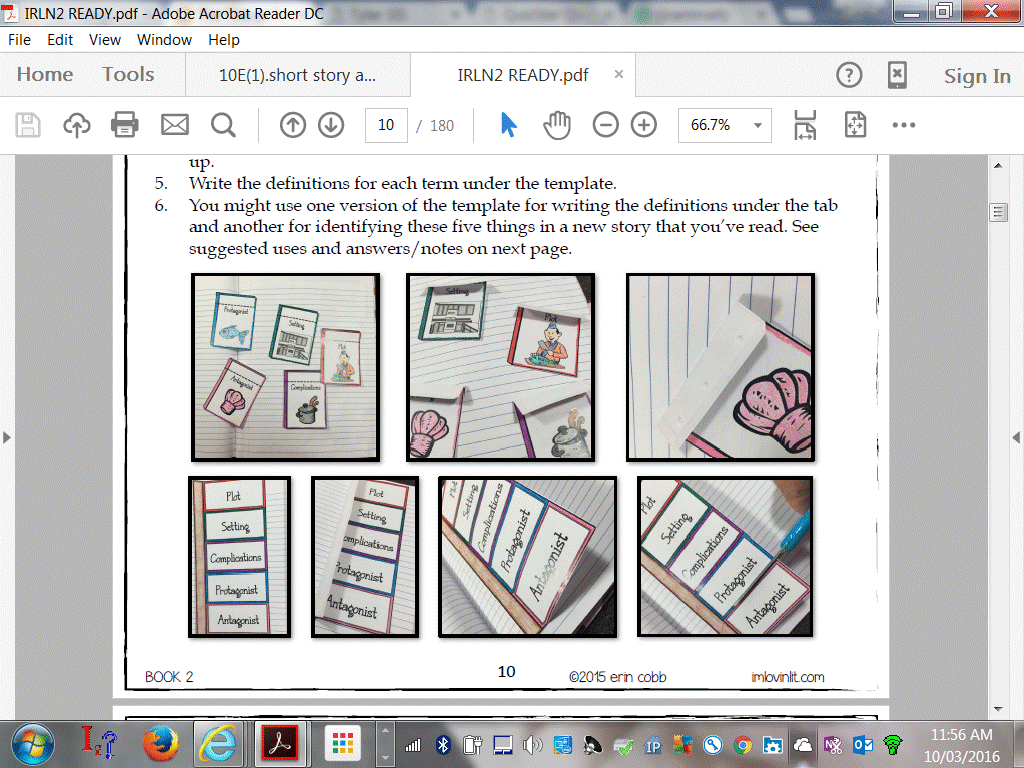
NOW LET'S MAKE THE PAGE FOR YOUR INTERACTIVE NOTEBOOK


1. Color and cut out the pieces of the templates

2. Fold the tab forward and glue only the tab down into the notebook so that it flips up.

3. Write the definitions for each term under the template

4. Add to Table of Contents!


Definitions for Page 2

plot – the chain of events that make up a story

setting – the time and place of a story

complications – problems that arise as characters struggle to reach their goals

protagonist – the main character in a story

antagonist – the character (or force) in conflict with the protagonist


Answers for Fugu:

plot – A puffer fish wishes to escape from the chef who plans to cook him.

setting – the chef’s kitchen

complications – The fish cannot get back to the water; the ocean he sees

is just a painting.

protagonist – the puffer fish

antagonist – the chef

Challenge: How would these answers be different if I told you
that the chef is the protagonist?


Don't Forget To Be Awesome!
ABOUT THE AUTHOR:

I am an educator with over 25 years of teaching experience; I currently teach English in the public school system of Virginia. In my spare time, I am an avid reader. writer, reviewer, blogger, writing/art journaler, beekeeper, grad student, and MOTHER. - See more: Here

INTERACTIVE ENGLISH NOTEBOOK


WHAT IT SHOULD LOOK LIKE...


NOTES


Don't Forget To Be Awesome!
ABOUT THE AUTHOR:

I am an educator with over 25 years of teaching experience; I currently teach English in the public school system of Virginia. In my spare time, I am an avid reader. writer, reviewer, blogger, writing/art journaler, beekeeper, grad student, and MOTHER. - See more: Here

5 Elements of a Story Booklet


Booklet Directions

1.  Cover: Draw and label Plot diagram, TITLE FOR BOOKLET is 5 Elements of a              Story by ______
2.  Define Exposition COMPLETELY
3.  Define Rising Action COMPLETELY
4.  Define Climax COMPLETELY
5.  Define Falling Action COMPLETELY
6.  Deine Resolution with all Synonyms Conclusion and Denouement COMPLETELY
7.  Define Plot:  A sequence of events in a story
8.  Paste information onto page 8


Don't Forget To Be Awesome!
ABOUT THE AUTHOR:

I am an educator with over 25 years of teaching experience; I currently teach English in the public school system of Virginia. In my spare time, I am an avid reader. writer, reviewer, blogger, writing/art journaler, beekeeper, grad student, and MOTHER. - See more: Here


Related Posts Plugin for WordPress, Blogger...